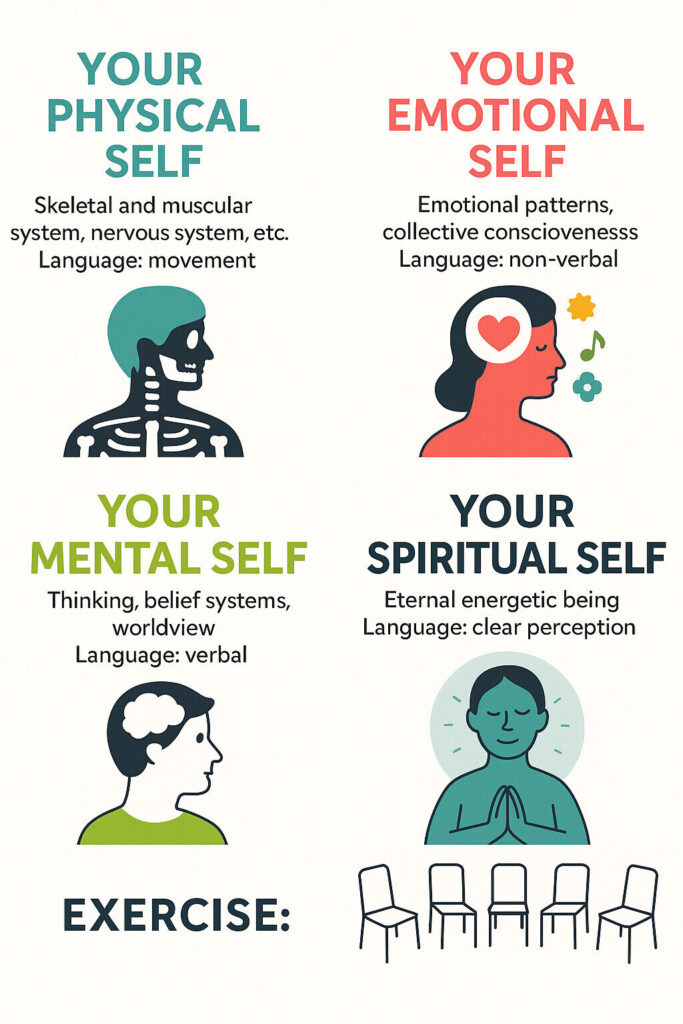
1.2.3 Your physical, mental, emotional and spiritual selves
In modern psychology, we increasingly recognize that human beings are not simply “minds in bodies.” Instead, we are multi-layered beings with physical, emotional, mental, and spiritual dimensions, all intricately connected (Ryff & Singer, 1998; Seligman & Csikszentmihalyi, 2000). When one dimension is neglected, the others inevitably suffer. When they are integrated, our sense of vitality, clarity, and purpose deepens.
This exercise invites you to connect with each of these aspects individually, then bring them together into a harmonious whole. It draws inspiration from holistic health models (Dossey & Keegan, 2016), humanistic psychology’s focus on self-awareness and self-acceptance (Rogers, 1961), and positive psychology’s strengths-based perspective (Peterson & Seligman, 2004).
Your Physical Self
Your physical self is the most tangible aspect of who you are—what you see in the mirror or via medical imaging. It includes your skeletal and muscular systems, nervous and endocrine systems, circulatory and immune systems, respiratory system, and sense organs.
Its language is movement—posture, breath, gestures, and the rhythms of your daily activities. Attuning to your body is not vanity; it is the foundation of well-being. Studies show that body awareness practices improve not only physical health but also emotional regulation and mental clarity (Mehling et al., 2011).
Your Emotional Self
Your emotional self is a rich, often underexplored territory. It holds your present-life emotional patterns, your transgenerational emotional heritage (Kellerman, 2001), and influences from the collective consciousness—the emotional “atmosphere” we share as humans.
Its language is non-verbal: colors, music, scents, energy fields, essential oils. Emotional experiences are stored in the body and can often be released or softened through sensory engagement rather than words alone (van der Kolk, 2014).
Your Mental Self
Your mental self is the architect of meaning. It encompasses your thinking patterns, mental programs, belief systems, worldview, and self-perception. Its language is verbal—words, inner dialogue, and structured thought.
Cognitive science shows that our self-talk and mental frameworks directly influence resilience, decision-making, and even immune function (Beck, 2011; Sapolsky, 2004). By listening carefully to your mental self, you can begin to identify beliefs that support or sabotage your flourishing.
Your Spiritual Self
Your spiritual self transcends the boundaries of time and matter. It is your eternal energetic being, connected to life through subtle energy systems, such as meridians described in Traditional Chinese Medicine. Its language is clear perception—intuition, telepathy, clairvoyance, and deep knowing.
While spiritual experiences are deeply personal, research in transpersonal psychology suggests they are linked to enhanced well-being, prosocial behavior, and resilience (Vaughan, 1986; Pargament, 2013).
The Five-Chair Integration Exercise
This practice uses embodied role-taking to deepen your awareness of each aspect of self. By physically moving between chairs, you invite a state shift in your body and mind, which supports more vivid self-awareness and integration (Gendlin, 1981).
Setup:
-
Place five chairs in a pentagonal shape.
-
Assign each chair: Physical Body, Emotional Body, Mental Body, Spiritual Body, and Complex Self.
Step-by-Step:
-
Physical Body Chair — Sit, quiet your thoughts, and feel your body. What sensations are present? What does your body need right now? Take slow, deep breaths for 1–2 minutes.
-
Emotional Body Chair — Shift to this seat. Again, quiet your thoughts. Notice your emotional state as sensations in the body. What does this part of you need? Breathe and soften.
-
Mental Body Chair — Move here. Notice the pace and tone of your thoughts. Are they kind? Harsh? Neutral? What beliefs are present?
-
Spiritual Body Chair — Shift to this seat. Drop into your inner stillness. What deeper wisdom or subtle impressions come to you?
-
Complex Self Chair — Finally, sit here. In your mind, look at each of your four aspects in turn and say gently, “Yes. Yes. Yes.” Let this affirmation invite unity.
Integration:
Write down your experience in your journal. What surprised you? Which part felt most alive? Which needs more attention?
References
-
Beck, J. S. (2011). Cognitive behavior therapy: Basics and beyond (2nd ed.). New York, NY: Guilford Press.
-
Dossey, B. M., & Keegan, L. (2016). Holistic nursing: A handbook for practice (7th ed.). Burlington, MA: Jones & Bartlett Learning.
-
Gendlin, E. T. (1981). Focusing. New York, NY: Bantam Books.
-
Kellerman, N. P. F. (2001). Psychopathology in children of Holocaust survivors: A review of the research literature. Israel Journal of Psychiatry and Related Sciences, 38(1), 36–46.
-
Mehling, W. E., et al. (2011). Body awareness: A phenomenological inquiry into the common ground of mind-body therapies. Philosophy, Ethics, and Humanities in Medicine, 6(1), 6.
-
Pargament, K. I. (2013). APA handbook of psychology, religion, and spirituality (Vol. 1). Washington, DC: American Psychological Association.
-
Peterson, C., & Seligman, M. E. P. (2004). Character strengths and virtues: A handbook and classification. Washington, DC: APA Press.
-
Rogers, C. R. (1961). On becoming a person: A therapist’s view of psychotherapy. Boston, MA: Houghton Mifflin.
-
Ryff, C. D., & Singer, B. (1998). The contours of positive human health. Psychological Inquiry, 9(1), 1–28.
-
Sapolsky, R. M. (2004). Why zebras don’t get ulcers (3rd ed.). New York, NY: Holt Paperbacks.
-
Seligman, M. E. P., & Csikszentmihalyi, M. (2000). Positive psychology: An introduction. American Psychologist, 55(1), 5–14.
-
van der Kolk, B. (2014). The body keeps the score: Brain, mind, and body in the healing of trauma. New York, NY: Viking.
-
Vaughan, F. (1986). The inward arc: Healing in psychotherapy and spirituality. Boston, MA: Shambhala.